Showing posts with label documentaries. Show all posts

4.22.2011

Cave of Forgotten Dreams - Werner Herzog in person @ The Natural History Museum Tomorrow Night 4.23.


Werner Herzog in person, members-only screening at the Natural History Museum.

Co-presented by Cinespia & First Fridays at The Natural History Museum of Los Angeles, in association with History Films, Goethe-Institut Los Angeles, Dublab, Levi's Film Workshop & MOCA

NOTE: Cinefamily member RSVPs to this event are temporarily closed. Your RSVP does NOT guarantee you a ticket. RSVP confirmations will be given to Cinefamily members ONLY, for a limited time. One RSVP per member (no +1s). RSVP will call tickets will be made available at the Natural History Museum at 4p, April 23rd. IMPORTANT: At 5p (30 min. before showtime), if you HAVE NOT picked up your RSVP will call ticket, IT WILL BE RELEASED to the standby waiting list.

Even though the screening of Cave of Forgotten Dreams is currently only available to Cinefamily members, all are welcome to the FREE closing night party, featuring multiple bands, DJs like Dntel (courtesy of Dublab), and general entry into the Museum and bar. Special musical guests for the evening TBA as well.

Join Cinefamily for the closing night party of their "Art In The Streets" series at the Natural History Museum, by celebrating the oldest form of street art ever recorded! Werner Herzog's brand-new documentary Cave of Forgotten Dreams gives you exclusive access inside the Chauvet caves of southern France, capturing the oldest known pictorial creations of humankind in their astonishing natural setting. Putting modern 3-D technology to a profound use, Cave transports you back in time over 30,000 years!

Natural History Museum of Los Angeles
900 Exposition Boulevard
Los Angeles, CA 90007

More Here...

Cave of Forgotten Dreams from Nate Calloway on Vimeo.

4.01.2011

@ CINEFAMILY: The Ecstatic Truths of Werner Herzog: Documentaries, 1971-1992 -


In recent years, audiences have become more aware of Werner Herzog’s skills as a documentarian, but a closer look at his career shows a fascination with the non-fiction form going back to the very beginning. No one has done more than Herzog to promulgate the deeper truth that every fiction film has an element of documentary, and that all documentaries are constructed fictions. Herzog’s docs show an appreciation for imagination, poetry, adventure, and most of all -- how documentaries at their best can be an expression of one artist’s vision of the world. Join Cinefamily for twelve of Herzog's finest!

“I've always made it very clear that for the sake of a deeper truth, a stratum of very deep truth in movies, you have to be inventive, you have to be imaginative. Otherwise you will end up with what cinema-vérité does - they are the accountants of truth. I'm after something deeper. I call it the ‘ecstatic truth’ - the ‘ecstasy of truth’.” -- Werner Herzog

4.1.

Lessons of Darkness
shown with
La Soufriere

La Soufriere - 7:30p
Before going to hell and back to film the near-impossible images of burning oil fields in Lessons of Darkness, Herzog first covered a different eruption: that of the looming, belching volcano ready to pop on the Carribean island of Guadaloupe. Scratching their collective death wish itch, Herzog and his camera crew arrive at the island’s deserted ghost-town village at a moment when the volcano could erupt at any time, and interview a couple of primo Herzogovian outsiders left behind, who await death-by-lava with a semi-insane equanimity. Our man’s in great form, evading toxic sulfur gas and filming gorgeous smoke clouds, demonstrating with this film more than any other his willingness to capture his visual poetry at all costs.
Dir. Werner Herzog, 1977, DigiBeta, 30 min.

Lessons Of Darkness - 8p
A work of catastrophic beauty and sublime horror, Lessons of Darkness finds Herzog fighting fire with fire, confronting devastation with an ironic grace. Filming the unfathomable destruction caused by the Kuwaiti oil fires of the first Gulf War as a series of breathtaking aerial tableaux, Herzog transforms a landscape ravaged by war into an image of an alien world. Herzog scores these infernal panoramas to the soaring arias of Mahler, Schubert, Verdi, and Wagner, punctuated by brief aphoristic voiceovers and titles designed more to provoke and overwhelm than to inform. As in his later nature documentaries, Herzog here confounds that humanistic view of our world which stands mute and uncomprehending in the face of disaster and savagery, for the brutish nature on display in these chilling Lessons is that of man himself.
Dir. Werner Herzog, 1992, DigiBeta, 50 min.

Fata Morgana - 9:45p
Herzog journeys to the Sahara to film mirages, goes home with some wonderously trippy footage, and has charming film critic Lotte Eisner narrate the Popol Vuh creation myth over the top. One of Herzog’s earliest features, Fata Morgana begins with a audacious zoned-out opening, and hits transcendent straight off before getting even stranger as its chimerical imaginary civilization passes from Golden Age to Decline. As well, the film crew shoots like tourists to a different planet where the presence of life is largely manifest through detritus and death: a car turns endlessly in circles, and a bearded man in welding goggles flourishes a monitor lizard at the camera. The onscreen subjects of Herzog and frequent collaborator Jörg Schmidt-Reitwein (who lensed 17 of Herzog’s films) are frequently enhanced by the mythic, mirrored properties of the heat haze, and an eclectic soundtrack that switches from Handel organ music to Leonard Cohen, and onto a weird local drum/piano duo. An absolutely stunning Herzog head film!
Dir. Werner Herzog, 1971, DigiBeta, 79 min.

4.2.
Wodaabe: Herdsmen of the Sun
shown with
Bells From The Deep: Faith And Superstition In Russia

Wodaabe: Herdsmen of the Sun - 7p
A rare example of Herzog tackling the "ethnographic" corner of the documentary genre, with wonderfully mystical results! Herdsmen of the Sun tells of the Wodaabe tribe, a nomadic African community (self-described as “the most beautiful people on earth”) who annually practices a festival called Gerewol, in which females choose their mates from a lineup of super-elaborately adorned men with wild makeup, feathers and kaledoscopic robes draping their seven-foot frames. Starting with the first scene, Herzog accentuates the ethereal nature of this rite further by layering early 20th-century recordings of opera on the soundtrack; the film’s dreamlike depiction of a foreign people, very much at odds with the purist cinema vérité tradition of ethnography without adornment, is the embodiment of Herzog’s own “Minnesota Declaration”: that through “imagination and stylization”, there can be such a thing as a poetic, ecstatic truth. Riverting, singular and totally heartfelt. Dir. Werner Herzog, 1989, DigiBeta, 52 min.

Bells From The Deep: Faith And Superstition In Russia - 8p
A bit like a gentle Herzog take on the concept of a mondo film, Bells From The Deep is a catalogue of highly unusual religious practitioners and mystics throughout the Russian world, from bizarrely cocky Jesus impersonators to mass exorcisms, all the way through to meditating hordes that emit animal-like croaks to achieve a higher plane. Some highlighted personalities are truly off the wall, yet some are grounded in a startling reality, such as the Tuvan throat-singing plainsmen set against a backdrop of ice flows, or the humble servant of God who makes his meager living playing his church's epic network of tower bells like a concert pianist (providing the film's most haunting sequence.) As Herzog provides no narration or overt editorializing, the film's primary objective becomes clear as its strange subjects speak for themselves: it's not about the faith in question, but rather how unique of a road it takes to clarify it.
Dir. Werner Herzog, 1993, DigiBeta, 60 min.

4.2.
The Great Ecstasy of the Woodcarver Steiner
shown with -
How Much Wood Would A Woodchuck Chuck


The Great Ecstasy of the Woodcarver Steiner - 9:45p
Woodcarver Steiner’s indelible minutes contain a perfect Herzogian subject: the “ski flier” who sails super-human distances -- a serene young man who is portrayed to exist on a more transcendent plane. Walter Steiner is a medal-winning, record-breaking Swiss ski-jumper whom Werner’s ultra-slo-mo camera routinely captures soaring impossibly, and with an eerie calm usually reserved for monks or yogis. When rendered in hundreds of frames per second, Steiner’s feats dissolve the notion of the act as mere sport, launching it to the level of unearthly art bathed in death-defying ecstasy -- a blissful state that Herzog (a former ski jumper as well) finds himself in whilst doing live color commentary throughout the film. Also featuring an unforgettable, ethereal score by regular collaborator Florian Fricke (aka Popol Vuh), Steiner is easily one of the most visually breathtaking of all Herzog’s films, documentary or otherwise -- so relish this opportunity to see it on the big screen!
Dir. Werner Herzog, 1974, DigiBeta, 45 min.

How Much Wood Would A Woodchuck Chuck... - 10:30p
Herzog's yen for discovering the bizarre amongst the mundane here extends to his discovery of an alien language, in this mid-’70s paean to the blindingly fast private code of the Cattle Auctioneer. Planted in the Middle American milieu Herzog would soon return to for 1977’s Stroszek, How Much Wood... is less concerned with the business of auctioneering as it is with the thrill of the “call” itself: how it arose as a language due to capitalism, how the winners at the Cattle Auctioneering World Championships grew to develop their skills, and the purely rapturous sensation of endless cascading machine-gun syllables.
Dir. Werner Herzog, 1976, DigiBeta, 44 min.

4.3.
Land of Silence and Darkness
- 7p
One of Herzog’s most deeply felt and compassionate documentaries, Land of Silence and Darkness profiles the extraordinary Fini Straubinger, who, after becoming deaf and blind as an adolescent, spent thirty bedridden years in near-isolation. Upon learning hand-to-hand communication, Straubinger found herself awakened, charged with the purpose of sharing this gift. Herzog follows his loquacious subject as she interacts with other deaf-blind pupils, revealing both profound loneliness and true intimacy; one exquisite sequence lingers on expressions of joy and anxiety as the 56-year-old educator and her friends take their first airplane ride, as another reveals disappointment when Straubinger is unable to break through to a withdrawn patient. Though Herzog surprisingly shot only three hours of footage during the making of the film, Land of Silence and Darkness explores its subject masterfully and methodically, culminating in a poignant final shot which Herzog himself called “absolutely unforgettable, a human drama played out in two minutes.” Dir. Werner Herzog, 1971, DigiBeta, 85 min.

4.3.
Echoes From a Somber Empire
- 9:15p
Echoes is Herzog's captivating Capturing The Friedmans-style jigsaw puzzle concerning Jean-Bédel Bokassa, former dictator of the Central African Republic, and Michael Goldsmith, (the film’s atypical “host”, rather than Herzog himself), a European journalist captured and tortured by Bokassa's regime. At first, only momentary scraps of information are revealed: testimony by Bokassa’s current wife, casual reminiscences from his many, many children, and file footage from his exile in France -- deliberately giving you the impression that Bokassa could be simply an upstanding puppet of colonialism. But, as Herzog criss-crosses the historical narrative, he delicately peels back layer after layer of the Bokassa onion (arbitrary executions -- impostor daughters -- casual cannibalism?!?!), letting a wildly complex, unforgettable portrait of a despotic madman bubble to the surface. Deeply unsettling from its opening “dream sequence” (a tableaux of migrating Christmas Island crabs, later re-used by Herzog in Invincible) right down to its impossible-to-forget final image, Echoes is possibly the greatest discovery of this entire series. Dir. Werner Herzog, 1990, DigiBeta, 93 mi

4.8.
God's Angry Man
shown with
Huie's Sermon

God's Angry Man - 7:45p
Dr. Gene Scott, the notorious televangelist whose paranoid grandiosity and fevered rantings made him easily the most complex (and subsequently entertaining) of his ilk, is the wildly entertaining subject of 1980’s God’s Angry Man. Herzog visits Scott on the set of the long-running nightly TV show “Festival of Faith”, filming him in both contemplative and full-on freakout modes; as he hurls bizarre, uncomfortable proclamations towards his at-home audience, Scott reveals himself to be not only passionate about his own teachings, but equally passionate about his own myth of personality. Herzog once called America “the most exotic country in the world”, and out of all his documentaries, God’s Angry Man goes the furthest to prove this point: as he alternately thrills to Scott’s maelstrom and to the creepy Xtian soft-rock musical interludes by Scott’s in-house backing band of pasty musicians with moulded hair, Herzog narrates the action in his native tongue for the film’s original German audience, hipping them to a taste of Americana as alien as the realm of Star Wars.
Dir. Werner Herzog, 1980, DigiBeta, 43 min.

Huie's Sermon - 8:30p
Made shortly after God’s Angry Man, the show’s second film finds Herzog capturing a very different, yet no less manic mode of preaching. Filmed at the Bible Way Church of Our Lord Jesus Christ in Brooklyn, Huie’s Sermon is the record of a single sermon delivered by its charismatic pastor Huie Rogers, who gradually builds in intensity from placid to a level so intense you’re amazed that he doesn’t drop dead on the spot from an aneurysm. Huie zig-zags across a minefield of hot-button anti-Christian issues (homosexuality, pollution and...artificial insemination...?), and keeps his congregation on its feet every second of the way. Herzog is less interested in the content of the sermon as he is in Huie’s pure immolative delivery, for this preacher burns as hot as the oil field fires of Lessons of Darkness.
Dir. Werner Herzog, 1981, DigiBeta, 43 min. -

4.8.
Jag Mandir: The Eccentric Private Theater of the Maharaja of Udaipur - 10p
“Herzog's oeuvre is often divided between his documentaries and his fiction films, but there are few directors for whom that distinction means so little -- in almost all of his work, fiction and reality weave together in complicated ways. This is certainly true of Jag Mandir, about a folk art festival arranged in a remote region of India...[t]he film is presented as a record of a festival arranged by the Austrian actor, singer and conceptual artist André Heller, at the behest of a Maharajah who wanted his young son to witness the glory of Indian artistry before such local traditions were erased in the face of "McDonaldization." The bulk of the film is dedicated to a simple document of the show itself: one group of performers after another takes the stage, dancing, playing music, juggling and displaying an array of marvelous costumes. The whole thing is pure spectacle, [b]ut the most impressive performance is probably the simplest, a traditional dance that Herzog excerpts at great length towards the end of the film: a mixed group of male and female dancers who continually rearrange themselves into delicately pulsating tableaux vivant. It is a hypnotic, beautiful slow motion dance, driven by stop/start rhythms and subtle choreography, and is a tremendous way to cap the grandeur and beauty of these rituals.” -- Ed Howard, Only The Cinema - Dir. Werner Herzog, 1991, DigiBeta, 85 min.

More Here...

The Ecstatic Truths of Werner Herzog trailer from Cinefamily on Vimeo.

8.29.2010

Go See - Jean-Michel Basquiat: The Radiant Child Now @ Laemmle's Pasadena

The opening credits of Jean-Michel Basquiat: The Radiant Child immediately exhibit this documentary's sense of clever, deliberate layering of visual and audio components. (See any number of docs with faux-weighty facts delivered via Powerpoint-style wipes — it’s more of a unique quality than you’d think.) Title card lettering drops in, character by character, in synchronization with the bebop backdrop of Dizzy Gillespie’s “Salt Peanuts.” Footage of the young artist dancing, working, and playing with pups in the studio scrambles alongside the frenetic song, as flashes of Jean-Michel Basquiat's drawings and paintings are introduced. It’s lively as hell, and the scene for Basquiat’s irresistible story is effectively set.

Born in 1960, the Brooklyn-raised Basquiat, as the film notes early on, first became famous for his art, “and then he became famous for being famous, and then he became famous for being infamous.” The film plays out through a carefully constructed and impeccably paced narrative, wherein myriad aspects of Basquiat’s eight-year career trajectory are illuminated in choice detail. From the beginning, director and producer Tamra Davis makes her role within the documentary and her relation to the artist transparent: she discloses that the intimate recurring interview footage of Basquiat was something she filmed “of my friend” in 1986, two years before his death. The footage, which until now sat in a drawer for 20 years, serves as the film’s centerpiece and anchor, one of the many effective devices that brings the artist to life.

Davis starts the story in New York City in 1978, when Basquiat arrives in Manhattan after dropping out of high school. The downtown New York art world first takes notice when unusual, phrasal graffiti appears around the city credited to an unknown SAMO© (“same old shit”), who is Basquiat and friends incognito. The content is telling, too: “SAMO© AS A NEO ART FORM” and “SAMO© AS A RESULT OF OVEREXPOSURE” foreshadow the artist’s forthcoming rise and fall. Next, Basquiat naturally falls into the city’s No Wave music scene by playing in a band called Gray (his first public work, one interviewee says), and regularly appearing on Glenn O’Brien’s public access television show TV Party. Then Debbie Harry (Blondie) makes the first purchase of a Basquiat painting for $200, not long after he’s given the funds to work with paint on canvas for the first time. Shortly thereafter, Basquiat has work featured in The Times Square Show, “the first radical art show of the ‘80s,” alongside artists like Keith Haring. These events catalyze Basquiat's efforts first into a viable career and then into a stratospheric presence as a top artist.

But the film’s allure doesn't ride solely on the clarity with which this chain of events is rendered. It’s also the emotional ebb and flow in tandem with the narrative that the filmmakers maneuver to great effect. By 'maneuver,' I don’t mean any undue manipulation of the viewer, but an accounting for the audience’s progressing state of mind. Basquiat's extraordinary story is told so compellingly here because of how the viewer is carried in emotional synchronization with him. We smile when he smiles, and we sigh when he sighs. He’s as charming as everyone tells us he is, and it’s easy to see how Basquiat ended up the leading figure in his cult of personality. Even Andy Warhol fell for him.

Beyond the artist’s personal life, the film does good work in contextualizing his art. The different personal likes that might figure into a present-day Facebook profile — like Basquiat’s love for BeBop jazz and the poetry of William Burroughs — are extracted from and discussed alongside his works. We’re shown with perfect clarity how he references and reinterprets their avant-garde techniques. Basquiat's work is also discussed in a wide range of interviews that include art-world figures like dealer/gallery owner Larry Gagosian and Museum of Modern Art chief painting and sculpture curator Ann Temkin. Music and art historians are also called in, in addition to friends of the artist like Thurston Moore, Fab 5 Freddy, and Julian Schnabel. What we get is a fairly holistic exploration of Basquiat by those who knew him best.

But delving further into some of the problematic ways the work and the artist were received helps complete this representation of Basquiat the phenomenon. If he was famous for his fame and later his infamy, as The Radiant Child tells us, the film concludes that it was complicated and had as much to do with the persona outwardly attributed to him as the way he managed to cope with it. We’re shown interviews where Basquiat bucks back against racist, reductive characterizations of his art (primitive and primal: “Like an ape? A primate?” he charges) that apparently constituted an embarrassingly large portion of the white liberal art criticism that took him into consideration. At least Temkin, the MoMA authority, takes a moment to concede that people in positions like hers are so immersed in "established" art that it can be hard to deal with new art that makes them uncomfortable. Hindsight, etc. But by the time the film and artist’s inevitable end arrives, it’s hard to swallow that quick fade to black. TinyMixTapes

More Here...

Jean-Michel Basquiat: The Radiant Child (Opening Scene)

4.16.2010

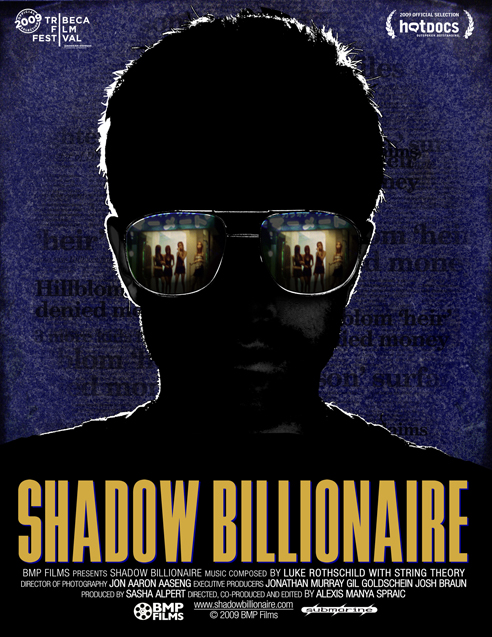
Go See - SHADOW BILLIONAIRE


Be on the lookout for Shadow Billionaire, a new documentary by Alexis Spraic about DHL Founder and billionaire Larry Hillblom who seemingly vanished into thin air when he failed to return from a routine flight in his vintage Seabee airplane. Before he was officially declared dead, bar girls throughout the Phillipines, Saipan and Vietnam came forward claiming to have children by Larry and seeking a piece of his vast fortune.

SHADOW BILLIONAIRE unravels the secretive life of this enigmatic and reclusive tycoon. The battle over his estate took on epic proportions, pitting impoverished teenage prostitutes against Larry’s former business associates and several of the largest law firms in the world.

A David and Goliath story, this documentary unravels a life of of mystery and exposes the underpinnings of how money, desire and greed clash when the stakes soar too high. If you liked Enron: The Smartest Guys in the Room, Boogie Man about Lee Atwater or the BBC doc Guys and Dolls, consider this a must-see. - Steve K

4.12.2010

TONIGHT: BANKSY's US Premiere 'Exit Through the Gift Shop' @ the Los Angeles Theater

Banksy's 'Exit Through The Gift Shop' is a guerrilla documentary which debuted at Sundance earlier this year. It's billed as "the world's first street art disaster movie" and centers on a dude named Banksy, Planet Earth's most infamous practitioner of politically charged urban art. Judging from the initial trailer we assumed Exit Through The Gift Shop would be a fly on the wall look at how Banksy conceives and executes his work but in a new five minute trailer, the incognito poster boy for the global street art movement offers a slightly different take: "The film's the story of what happened when this guy tried to make a documentary about me." he says "But he was actually a lot more interesting than I am so now the film is kind of about him." - Pedestrian TV

Monday 12th April 2010.

Doors Open at 7pm - Film starts 8pm

Film Duration 88 mins.

After show drinks in the Theatre Ballroom.

Los Angeles Theatre, 615 South Broadway, LA, 90014 213.629.2939 - cross street 6th. Passenger Drop Off outside Theatre.

Nearest Parking Pershing Square Parking Lot, 532 South Olive Street, LA, CA 90013 - cross street 5th street.

Theatre will be sign-posted from Pershing Square Parking lot.

Click here to see the walking directions from car park to theatre.

4.06.2010

Frederick Wiseman's 'MEAT' @ RedCat this Thursday 4.8

Award-winning documentary filmmaker Frederick Wiseman has created a body of work that offers a grand panorama of American life, studying human and institutional behavior in all their contradictory and unpredictable manifestations. In Meat (1976), Wiseman tracks the workings of a highly automated packing plant, illustrating important points and problems in the production, transportation, logistics, equipment design and labor management that turns cattle and sheep into consumer goods.The evening will be introduced by Josh Siegel, The Museum of Modern Art's Associate Curator in the Department of Film. Siegel has organized more then eighty exhibitions, including The Lodz Film School of Poland: 50 Years; To Save and Project: The MoMA International Festival of Film Preservation; and retrospectives devoted to artists/filmmakers including Jeanne Moreau, Nicholas Ray, Oskar Fischinger, Ken Jacobs, John Frankenheimer, Errol Morris, and the current, 2010 focus on the films of Frederick Wiseman.


3.16.2010

Thursday 3.18 @ CINEFAMILY - Cinema Eye Honors presents: What's Up, Docs?


"In an age where most docs are grafted over by pop narratives for greater suspense, drama or momentum, 45365 works specifically because of its wonderfully curated aimlessness."
- GreenCine Daily

From the patrol car to the courtroom, the playground to the nursing home, the parade to the prayer service, 45365 explores the congruities of daily life in a small American town -- Sidney, Ohio, to be exact. The stories of a father and son, a young relationship, cops and criminals, officials and their electorate coalesce into a mosaic of faces, places, and events. First-time filmmakers Turner and Bill Ross not only do a fantastic job collecting engaging documentary subjects unfettered by the presence of their cameras, but also crafting a mood in which they trust you'll be persistent, that you'll let their quiet rhythm build -- that your enjoyment of the unforced cinematic whisper is not only OK, but desired in its own right.

Dirs. Bill Ross IV & Turner Ross, 2009, 90 min.

More Here...


3.01.2010

THURSDAY 3.4. @ CINEFAMILY - Top Value Television

Radical, hilarious and influential, "Top Value Television" was an ad hoc collective of documentarians whose pioneering use of portable, low-tech video gear allowed them unprecedented behind-the-scenes access to everything from presidential conventions to the Super Bowl. The Cinefamily celebrates the TVTV spirit, and the top notch documentary filmmaking they produced, with a panel discussion/reunion of TVTV members, a video "primer" of past works, and a screening of Lord Of The Universe, an expose on sixteen-year-old Guru Maharaj Ji and the national gathering of his followers at the Houston Astrodome.

More Here...

2.02.2010

HOWARD ZINN Tribute at Santa Monica Museum of Art Thursday 2.4.

Thursday, February 4, 8p

A Collection of Ideas... A Tribute to Howard Zinn


Selected clips from Howard Zinn's new documentary, The People Speak, with special guest Peter Sellars. Using dramatic and musical performances of diaries, letters, and speeches by everyday Americans, The People Speak gives voice to those who valiantly spoke up for social change throughout U.S. history. Produced by Matt Damon, Josh Brolin, Chris Moore, Anthony Arnove, and Zinn, The People Speak illustrates the magnitude of these passionate historical moments and reminds us never to take liberty for granted.

*Note: Program Change: Howard Zinn was due to speak at SMMoA about his new documentary, The People Speak. Following Zinn's death on Wednesday, January 27, the event has become a tribute to this remarkable man and his work.

The event is now full.
A stand-by line will open at 7p; seating is not guaranteed. Admission $25; $10 SMMoA members. Proceeds from the event will go to support the Educational Fund of The People Speak, a charitable initiative which brings this powerful documentary into schools and communities free-of-charge.


More Here...

9.28.2009

Tonight @ CINEFAMILY - The Revolution Will Not BeTelevised

The Revolution Will Not Be Televised is a powerful documentary about the charismatic and controversial President of Venezuela, Hugo Chávez. It charts the seven-month run-up to the dramatic attempt to overthrow him in April of 2002, and provides an eyewitness account of the coup d'etat and the extraordinary return to power of Chávez some 48 hours later. Unique footage of Chávez, the new icon of the Left and thorn in the side of the Bush administration, is assembled in this electrifying documentary.

The screening will be introduced by the film's co-executive producer, Rod Stoneman, who has recently published a book outlining how this popular and prize-winning documentary soon came subject to extensive attack (including a formal BBC enquiry.) He will discuss the production and reception of this controversial work, in the context of the contemporary global economy of the media.

Dirs. Kim Bartley & Donnacha O'Briain, 2003, digital presentation, 74 min.

8p

More Here...


9.25.2009

at the Downtown Independent Friday night : MOCHILLA Presents: STILL BILL- The Story of Bill Withers

Still Bill
Directed by Damani Baker and Alex Vlack, Still Bill tells the story of Bill Withers, an unexpected superstar. "Ain't No Sunshine", "Lean on Me", 'Grandma's Hands"Use Me" and "Just the Two of Us" are only part of a complex and fascinating character: an icon who left the industry behind but never gave up his soul. You know his songs. Now meet the man.

Featuring a tribute concert, a soundtrack with previously unreleased tracks, and rare live performance.

**Everyone is welcome and encouraged to bring a Bill Withers record to play!

DJ's + Special Guests TBA*

Friday at 3p 5p and 930p

More Here...

Additional Still Bill screenings:
September 26th at 3pm, 5pm and 7pm and
September 27th at 2:30pm and 4:30pm

STILL BILL Trailer

6.16.2009

The American Cinematheque at the Aero Theatre Presents... Agnes Varda


THE BEACHES OF AGNES
June 24 - July, 1, 2009

Director Agnes Varda In Person with A Sneak Preview
of Her Latest Film: THE BEACHES OF AGNES

A gifted and outspoken feminist and one of the most acclaimed directors anywhere in the world, Agnes Varda could be considered the prototype of today’s independent filmmaker. Varda is a survivor, a stubborn and patient observer of her time and her people, like the pop singer in CLEO FROM 5 TO 7, the lovers in LE BONHEUR (HAPPINESS) or the drifter in VAGABOND. "I have fought so much since I started … for something that comes from emotion, from visual emotion, sound emotion, feeling, and finding a shape for that," Varda has said. Varda directed her first feature, LA POINTE COURTE, in 1954, with no formal training in filmmaking. The movie has often been identified as the film that started the French New Wave ("and a famous flop," as Varda has wryly noted). Along with Alain Resnais and Chris Marker, she made up the so-called "Left Bank Group" of the early 1960s, distinct from other New Wave directors for their interest in both documentary and fiction and their passion for both political and social filmmaking. Her marriage to Jacques Demy (1931-1990) made her one-half of the most beloved filmmaking couple of their day, and her tribute to Demy, JACQUOT DE NANTES, is one of her finest films.

Plus a Mini-Retrospective!
AGNES VARDA IN PERSON TRIBUTE
Including two documentaries capturing 1960s Los Angeles - shot when Varda and husband Jacques Demy lived in LA!

More Here...


5.28.2009

At Norton Simon Tonight


A Model for Matisse


Tonight at 7p - This documentary explores the little-known relationship between the legendary 20th-century artist Henri Matisse and French Dominican nun Sister Jacques-Marie, who inspired him to create his final masterpiece, the Chapelle du Rosaire (Chapel of the Rosary) in Vence, France. Directed by Barbara Freed, Professor of French and Applied Linguistics at Carnegie Mellon. (67 minutes)

More Here